|
The Story of "The Comeback Kids, the Elephants of Addo" The Story of The Comeback Kids, the Elephants of Addo BAR
|
The Comeback Kids - Elephants of Addo
At the beginning of the 20th Century, a land developer had encouraged European settlers to farm in the valley, 50 miles inland from the Indian Ocean. After much hardship, they established some crops, which were promptly raided by their delighted neighbors – the Cape elephants. For the aggrieved settlers, the solution was simple.
An ex-war hero, Major Jan
Pretorius, CMG, DSO and Bar, was hired to shoot all but ten elephants.
Pretorius was a renowned game hunter, but his job was difficult. Panicked
elephant families fled into the thick, impenetrable Addo bush, and a
man’s life was in great danger if he tracked them there. However, a year
later, Pretorius declared the job “done”. By his count, 114 elephants
were dead and only 11, some seriously wounded, survived in the dense
spekboom of Addo.
The
first priority was to build a fence around the vest-pocket park – one
that no elephant could push down. All efforts failed for many years,
until the park’s second warden, Graham Armstrong, devised a fence made
of stout railway ties placed at short intervals and connected by rows of
tramline and steel elevator cable. The second priority was to encourage the elephants to feel safe around people. Once again, an appeal was made to their stomachs. Tons of over-ripe oranges and vegetables were dumped in an open space and the elephants could not resist it. They became accustomed to visitors, but citrus fruit has had to be banned from the park, for some elephants will force a vehicle open to get at it. In
the protected sanctuary of Addo Park, the elephants have quickly increased
their numbers.
I
have always sought out the company of elephants from Northern Kenya down
to Zimbabwe, and west to Namibia, but nothing prepared me for this sight.
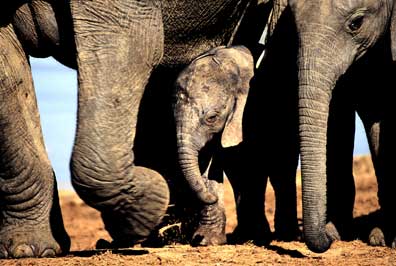
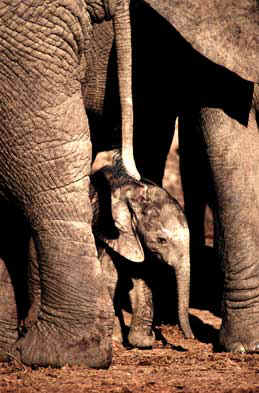
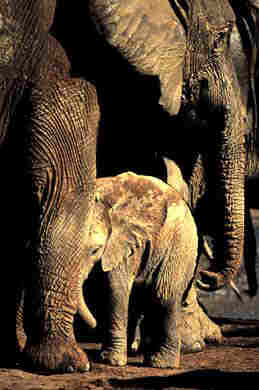
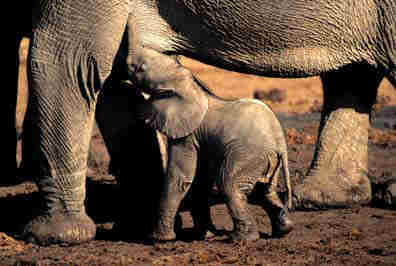
At a man-made waterhole, called Hapoor, tiny newborns struggled to keep up
with the incoming and outgoing herds, lost in a forest of giant legs,
tails and dust. They clung to the sides of their watchful mothers and were
herded by their ever-vigilant older brothers and sisters. Confident youngsters, who had mastered the art of swinging a trunk and keeping their balance on stumpy legs, charged at birds or other elephant babies. But always they returned to stand in the shade under their mother’s belly, or to slumber against her protective leg. Some even snoozed alongside my over-sized camper truck.
Africa’s history is land-mined with massacres, inflicted on both animals and humans, over thousands of years. But as you view these images of youngsters beginning life with such vulnerability and such pleasure, do you find yourself asking – as I do – how can we change the past patterns of humankind? Will the descendants of the Comeback Kids survive the next century? And if they do not, how were you and I responsible for their loss? MENU BAR |
| © Arlene Gawne |

 Elated, I photographed and sketched
these
youngsters who are truly the
Comeback Kids, only
2 to 3 generations
removed from massacre.
Elated, I photographed and sketched
these
youngsters who are truly the
Comeback Kids, only
2 to 3 generations
removed from massacre.